


The cryptocurrency market in late 2025 is in one of its messy, emotional phases: pockets of optimism, sharp pullbacks, and constant debate about which projects will still matter in five or ten years. Cardano (ADA) sits right in the middle of this conversation. Built on peer-reviewed research and a proof-of-stake consensus model, Cardano has long marketed itself as a more methodical, sustainable alternative to first-generation blockchains.
As of early December 2025, ADA trades around $0.43 per coin and ranks among the top cryptocurrencies by market capitalization, with estimates around $15–20 billion depending on the data provider and intraday moves. That is a far cry from its all-time high near $3.10, but still a huge upgrade from its early-stage pricing. For investors, traders and long-term holders, the central question is simple: what does the future of ADA look like from here?
Instead of guessing, this guide focuses on Cardano price prediction: third-party outlook. We will walk through forecasts from well-known platforms such as DigitalCoinPrice, WalletInvestor, Benzinga and Gate, plus some highly bullish sponsored analyses that make headlines. Then we will connect those projections to fundamentals like Cardano’s technology, tokenomics, competition and regulatory environment.
The goal is not to tell you whether to buy or sell, but to give you a clear, balanced picture of how different analysts and models see ADA’s potential path from 2025 to 2030 and beyond. Throughout, remember that no ADA price prediction is guaranteed; crypto remains one of the most volatile asset classes in existence.
Cardano today: price, market cap and on-chain context
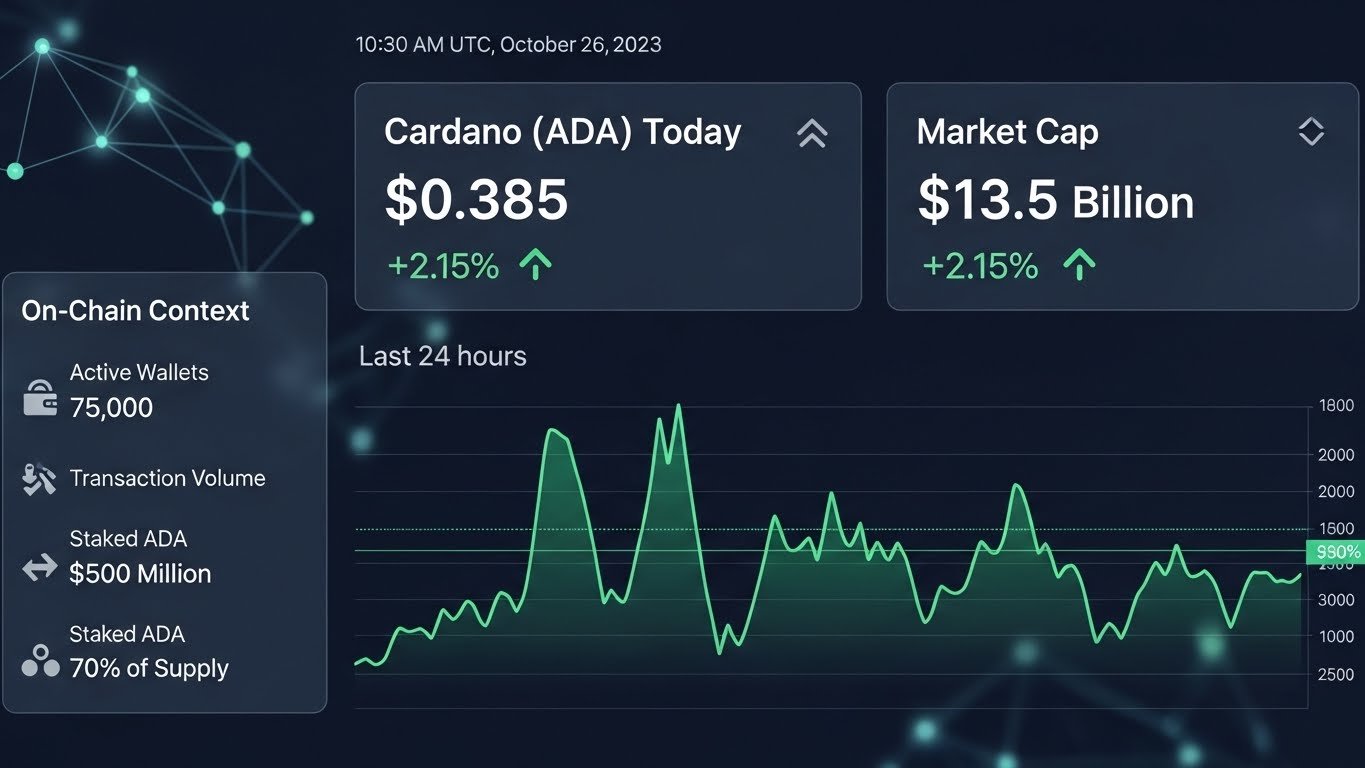
Cardano is currently priced around $0.43 per ADA with intraday highs and lows fluctuating around that level. Market-data providers like Gate and Changelly show ADA near the top ten by market cap, with capitalization roughly in the mid-teens of billions of dollars and daily trading volumes comfortably in the hundreds of millions.
Gate’s 2025 market overview notes Cardano as roughly the eighth-largest crypto asset by market cap, at around $15.21 billion, with recent 24-hour volume of about $643 million and a circulating supply in the mid-thirty-billion ADA range. This fits with Cardano’s long-standing design: a capped maximum supply of 45 billion ADA, a large portion of which is staked, and a controlled, relatively predictable issuance schedule.
Current ADA price snapshot
Stock market information for Cardano (ADA)
The live market data shows ADA trading a little under half a dollar. That sets the baseline for any Cardano price prediction discussed in this article: every target you see, whether conservative or wildly optimistic, starts from roughly this $0.40–$0.45 zone as of December 8, 2025.
Why third-party Cardano price prediction models are so mixed
Before diving into numbers, it helps to understand what these forecasting platforms are actually doing. Sites like DigitalCoinPrice, WalletInvestor and Changelly typically combine:
More editorial outlets, such as Benzinga or exchange blogs like Gate’s Crypto Wiki, layer qualitative analysis on top: they look at Cardano’s roadmap, its DeFi ecosystem, potential partnerships (for example in Africa or identity projects), and compare ADA to competing smart-contract platforms.
Then there are aggressive promotional articles and presale comparisons that claim ADA could reach $3, $8 or even more in just one cycle. These often appear on media sites as “partner content” and should be treated as marketing rather than neutral analysis.
The result is a wide spectrum of Cardano price predictions, from modest, range-bound forecasts to highly speculative moon-shot scenarios.
Short-term Cardano price prediction (2025–2026)
2025 ADA forecasts from major third-party platforms
Different forecasting engines see 2025 in very different ways.
DigitalCoinPrice provides one of the more structured ADA price forecasts. For 2025, their table shows a minimum price around $0.39, an average near $0.84, and a maximum projection of about $0.95. On top of that, their narrative suggests Cardano could “pass the $0.95 mark by the end of this year” if market conditions cooperate.
Benzinga’s December 2025 analysis compiles forecasts from multiple sources (including WalletInvestor, CoinCodex, Changelly and others) and arrives at an “average” Cardano price prediction for 2025 of about $0.945, with bullish scenarios as high as $1.376. Their article also acknowledges that these ranges assume growing DeFi adoption, better throughput via upgrades, and successful real-world projects.
Gate’s educational piece sketches a slightly wider and more narrative-driven range. It suggests that in 2025 ADA could trade roughly between $0.66 and $1.88, with an upside “bullish target” near $2.36, depending on how Cardano executes its roadmap and how broader market cycles play out.
Taken together, these third-party views cluster around a core idea:
If Cardano continues to deliver incremental upgrades and benefits from at least a moderately positive crypto market, ADA’s 2025 price may reasonably revisit the $0.80–$1.20 zone, with occasional spikes above that if sentiment turns strongly bullish. None of these mainstream platforms guarantee those levels, but they largely agree that a complete collapse to near-zero is less likely than a sideways-to-up trend from current prices.
WalletInvestor’s short-term stance
WalletInvestor, which leans heavily on technical analysis, is somewhat more cautious in the near term. As of December 8, 2025, it shows ADA near $0.431 and projects a one-year target around $0.600, implying roughly 39% upside from today’s level. Their five-year Cardano price prediction for 2030 is about $1.318, and they classify ADA as a “very good long-term (1-year) investment” in their model.
What matters here is not whether 0.60 is precise, but the direction: WalletInvestor’s model sees a gradually rising ADA price, not an explosive move to new highs within the next year.
2026 scenarios: consolidation or breakout?

When the horizon shifts to 2026, the divergence between Cardano price predictions becomes more obvious.
DigitalCoinPrice’s 2026 table shows ADA with a minimum price near $0.93, an average around $1.04, and a maximum near $1.08. In that model, Cardano does not explode upward immediately after 2025; instead, it stabilizes slightly above the 2025 range and builds a base for further growth.
WalletInvestor, by contrast, looks further ahead and expects ADA to reach about $1.318 by late 2030, which, if progress is relatively smooth, could place ADA around the low-to-mid $1 range in the mid-2020s. Their system highlights upside, but not overnight parabolic moves.
More aggressive voices appear in sponsored articles and altcoin comparisons. Some partner pieces suggest Cardano could return to its all-time high near $3 during the current cycle, citing strong technical indicators and network progress. Other hype-driven forecasts go even further, floating possible $8 ADA by 2026 under very bullish assumptions that include ETF approvals, institutional inflows and a powerful market-wide bull run.
The key takeaway is that mainstream analyst models generally see ADA in the $1–$2 bracket over the next couple of years, while promotional content sometimes projects far higher prices that depend on perfect conditions and aggressive risk-taking across the market.
Long-term Cardano price prediction (2030 and beyond)
Moderate long-term growth camp
On a longer timeframe, third-party ADA forecasts diverge even more.
Benzinga’s research, which aggregates several sources, suggests that by 2030 Cardano could trade in a range between roughly $0.130 and $0.801, with an average projection around $0.341. This is a surprisingly conservative outlook: their model implies that ADA might struggle to sustain prices well above $1 unless Cardano dramatically accelerates adoption and development.
WalletInvestor again comes out somewhat more optimistic. Its Cardano price prediction for 2030 sits at approximately $1.318, implying more than a tripling from today’s level but still far below the aggressive $5 or $10 targets sometimes floated on social media. In this view, Cardano slowly but steadily appreciates as the network matures and the wider crypto market expands.
For many long-term investors, these moderate forecasts can actually be reassuring. They frame ADA not as a get-rich-quick vehicle, but as a speculative growth asset whose returns depend on real usage, technological progress and macro conditions, rather than pure hype.
Aggressive bull projections: DigitalCoinPrice and hyper-bullish media
DigitalCoinPrice provides one of the clearest examples of a structured, yet bullish, multi-year Cardano price forecast. Their table has:
In other words, DigitalCoinPrice’s third-party outlook imagines a world where Cardano gradually reclaims and then surpasses its previous all-time high over several years, assuming sustained network development, adoption and market growth.
Even more aggressive narratives appear in sponsored pieces that call Cardano a “top crypto to invest in,” sometimes pointing to $8 ADA by 2026 and comparing it to high-beta presale tokens that advertise 50x or 100x potential returns. These articles often highlight whale accumulation, potential ETFs or payment integrations, but they are marketing-heavy and should never be confused with neutral research.
From a risk-management perspective, the responsible way to read these extreme Cardano price predictions is as “best-case dream scenarios” rather than base cases. History shows that crypto can indeed overshoot to astonishing levels in euphoric bull markets, but timing and magnitude are extremely hard to predict.
Fundamentals behind the Cardano price outlook
Technology, roadmap and ecosystem
All serious Cardano price forecasts pay attention to the chain’s underlying technology. Cardano’s selling points include:
Upgrades like Hydra (for off-chain scaling) and Mithril (for faster, lighter client verification) are intended to make the network more scalable and user-friendly. If these technologies are widely adopted and enable smoother DeFi, NFT and real-world applications, they reinforce the bullish side of the ADA forecast.
On the other hand, Cardano has often been criticized for slow rollout of major features and a smaller dApp ecosystem compared to competitors like Ethereum and Solana. Even Benzinga’s balanced analysis flags slower development and weaker DeFi traction as headwinds that could cap ADA’s long-term upside.
Tokenomics and staking
Cardano’s tokenomics are a central part of its long-term story.
High staking participation can support price in several ways. It reduces the liquid supply available to sell, encourages long-term holding and provides yield to participants. At the same time, if market sentiment turns negative and stakers suddenly decide to unstake and exit, additional supply can hit the market and deepen drawdowns.
Nearly all third-party Cardano price predictions assume that staking remains attractive, Cardano’s monetary policy stays on track, and no unexpected token-supply shocks occur.
Competition and regulation
Cardano does not exist in a vacuum. Competing smart-contract platforms, including Ethereum, Solana and various newer Layer-1 and Layer-2 chains, are fighting for the same developer and user mindshare. Analyst reports frequently point out that Ethereum’s massive network effects and Solana’s high-throughput architecture remain powerful competitive threats.
Regulatory developments also matter. Positive news such as potential ADA-based products, clearer legal classifications or government-backed pilots could boost sentiment. Negative developments, like strict securities classifications or restrictive rules for staking, could do the opposite. Many models implicitly assume a “mixed but improving” regulatory environment; dramatic regulatory shocks are hard to bake into a deterministic ADA price forecast.
Risks that could derail optimistic Cardano price predictions
Every Cardano price prediction is built on assumptions, and any of those assumptions may fail. Some of the main risks that third-party analyses mention include:
Conclusion
Cardano has spent years building a reputation as a thoughtful, research-driven blockchain, and that reputation still shapes how analysts view it today. Most mainstream platforms see ADA as a project with real potential, meaningful technology and a non-zero chance of outperforming the broader market if its roadmap and ecosystem continue to advance.
At the same time, the numbers behind Cardano price prediction: third-party outlook range from cautious to wildly optimistic. Some models cluster around the idea of ADA grinding its way into the $1–$2 range over the next cycle, while others envision a path back to $3 and beyond in the early 2030s. A few highly promotional pieces even float $8 ADA within just a few years, though those require an almost perfect storm of adoption, sentiment and liquidity.
The sensible approach is to read these forecasts not as promises, but as maps of possible futures. They highlight the conditions under which ADA could perform well—such as successful upgrades, growing DeFi usage and a friendlier regulatory environment—and the risks that could cap or reverse its progress.
If you decide to engage with Cardano at all, let these models guide your questions rather than dictate your decisions. Ask yourself what you believe about the future of smart-contract platforms, how much volatility you can handle, and how ADA fits into your broader financial life. In the end, the most important prediction is not what ADA will trade at in 2030, but whether your strategy can withstand whatever path the market actually takes.
FAQs
What do most analysts think Cardano will be worth in 2025?
Across major third-party platforms, many Cardano price predictions for 2025 fall roughly in the $0.80 to $1.20 range, with some models extending the upper bound closer to the low-$2 area in bullish scenarios.
Can Cardano realistically reach $10 or even $100?
In the near to medium term, a $10 ADA price would already imply a massive increase from current levels and a very large market cap.
Why do different Cardano price predictions disagree so much?
Third-party ADA price forecasts use different methods and assumptions.
Is Cardano a safer bet than newer altcoins with higher upside?
Safety and upside are two sides of the same coin.
How should I use third-party price prediction sites when evaluating ADA?
The best way to use Cardano price prediction sites is as a source of ideas and scenarios, not as a script for your portfolio.
See more;Crypto News Today Price Prediction Expert Analysis & Market Forecasts 2025
