

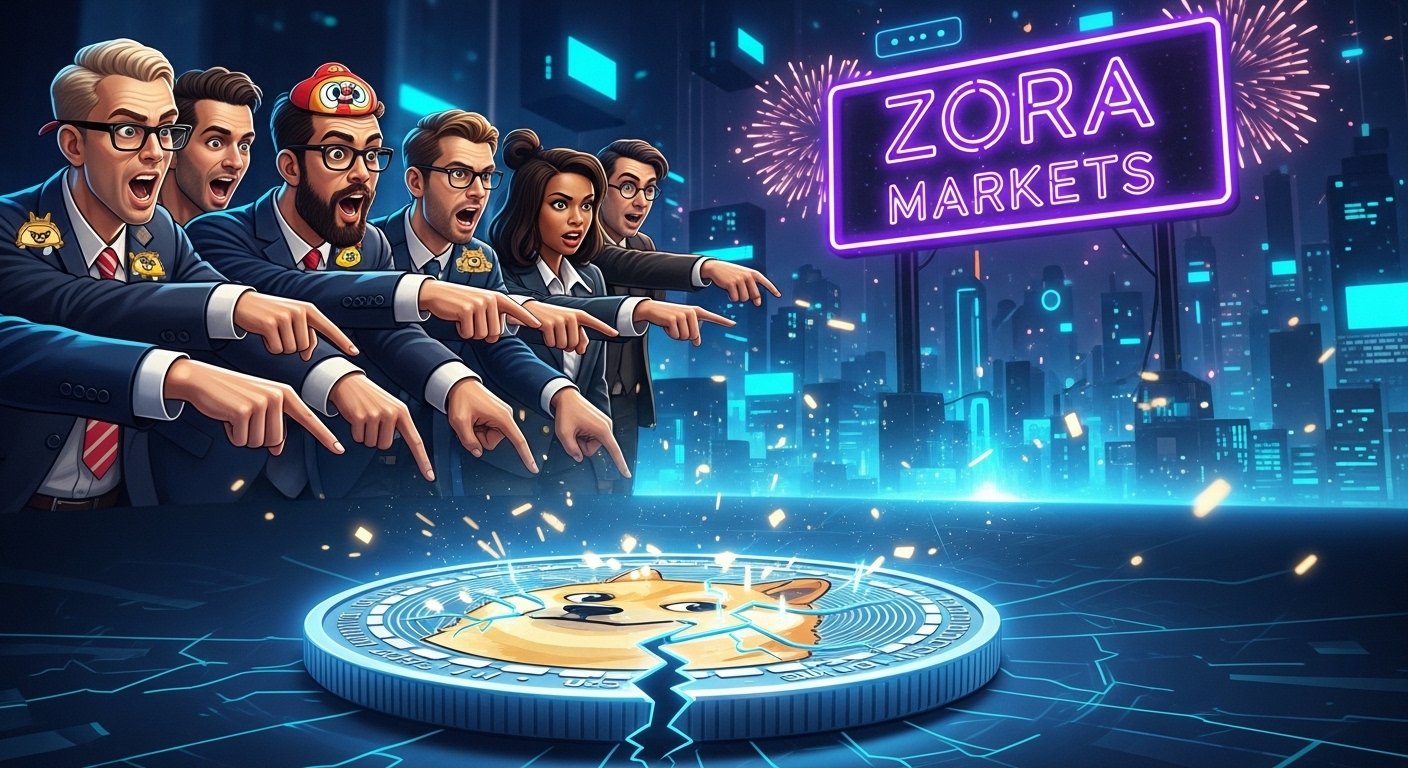
The meme coin market reversal that traders have quietly anticipated for weeks is finally beginning to take shape — at least according to the analysts and on-chain data firms who watch this volatile sector most closely. After meme coins collectively shed nearly 24% of their total market cap over the past 30 days, with the combined sector sitting at approximately $30.7 billion and barely moving week-over-week, the prevailing mood among retail investors has been one of deep pessimism. Yet it is precisely this kind of fearful, beaten-down sentiment that has historically marked the bottom of previous meme coin cycles — and some of the sharpest minds in crypto are saying this time is no different.
In this edition of meme coin news, we break down what the latest data from Santiment reveals about a potential trend shift, explain how on-chain social platform Zora is reinventing meme trading with its landmark launch of attention markets on Solana, and explore how Pump.fun — the dominant meme coin launchpad on Solana — has responded by overhauling its creator fee model. Together, these developments paint a picture of a sector that is not dying, but actively evolving — and potentially on the verge of its next significant move.
Meme Coin Market Reversal: What the On-Chain Data Is Telling Us
Anyone tracking meme coin news regularly knows that sentiment is often a more reliable indicator than price action alone. And right now, the sentiment picture is, counterintuitively, one of the most bullish signals available. Analytics platform Santiment — whose on-chain and social data tools have developed a strong track record for identifying inflection points in crypto market sentiment — has flagged that crowd fear in the meme coin sector has reached levels historically associated with near-term bottoms.
The logic is classic contrarian theory: when the crowd panics, early buyers accumulate. When the herd eventually reverses its view, those early positions generate outsized returns. Santiment’s crowd sentiment metrics show that retail enthusiasm for meme coins has cooled dramatically from the euphoric peaks of early 2025 — a period defined by the launch of high-profile political tokens including Official Trump (TRUMP) and the brief mania that followed. Today’s market participants are largely scarred by those events, which is precisely why the meme coin market reversal thesis is gaining credibility.
Supporting this reading is the broader structure of the market’s decline. The total meme coin market cap registered a week-over-week loss of just 0.3% in the most recent reporting period. This is not a collapse — it is a grind. Sellers appear exhausted, and the pace of new selling has slowed to a trickle.
If Bitcoin stabilizes and begins its next leg upward — a move many analysts anticipate as BTC has historically found support in the $85,000–$93,000 zone — meme coin trading volume could surge rapidly, just as it has in every prior cycle.
Key On-Chain Metrics to Watch for a Meme Coin Reversal
For traders serious about timing the meme coin market reversal rather than reacting to it after the fact, a handful of specific indicators deserve daily attention. First and most important is Santiment’s crowd sentiment score: when this metric transitions from sustained negative readings toward neutral, it often marks the earliest reliable signal that sentiment is beginning to shift. Second, watch meme coin trading volume across Solana’s decentralized exchanges — particularly on platforms like Raydium and Jupiter. When daily volumes begin climbing consistently for three or more days in a row, it indicates new capital entering the ecosystem.
Third, track launchpad activity on Pump.fun via Dune Analytics. The platform recently supported nearly 35,000 coin launches in a single 24-hour period, a figure that, while dominated by speculative micro-caps, also reflects underlying user engagement. When that engagement accelerates, broader retail participation tends to follow. Finally, Bitcoin’s price behavior against key resistance levels acts as the macro catalyst — because meme coins historically amplify Bitcoin’s directional moves by a factor of three to five times, a decisive BTC breakout would likely carry meme coin news headlines back to mainstream financial media quickly.
Zora Debuts Attention Markets on Solana: Reinventing Meme Trading
Think of it as a prediction market for internet culture. If you spot a hashtag gaining momentum before it explodes across X or TikTok, you can open a position in that trend and profit if your read on its virality is correct. Zora’s attention markets operate through a “Pairs” model — users can create markets under a broader “Trend,” and those pairs offer creator rewards that provide a financial incentive for identifying the next breakout cultural moment before it peaks. Anyone can pay 1 SOL (approximately $85 at launch) to deploy a new Trend, a deliberate friction mechanism designed to prevent the platform from being overwhelmed by spam — a perennial problem that has plagued meme coin launchpads throughout their history.
Zora co-founder Jacob Horne described the shift plainly: instead of only allowing an individual creator to pair their own content, the new model opens market creation to the entire community. This democratization of the ability to monetize cultural attention is a significant departure from Zora’s roots and positions it squarely as a competitor in the high-stakes launchpad arena that Pump.fun has dominated. The distinction lies in the asset being traded: Pump.fun trades tokens tied to arbitrary ticker symbols and memes, while Zora’s attention markets trade tokens tied to the popularity of specific cultural phenomena.
Why Solana Was the Right Choice for Zora’s Attention Markets
The decision to build Zora’s attention markets on Solana rather than remaining on Base was driven by the mechanics of viral trends. Internet culture moves in seconds. A meme or hashtag can go from obscure to globally saturated within hours, which means the infrastructure for trading those trends must be fast enough to keep pace. Solana’s sub-second block times and transaction costs measured in fractions of a cent make it architecturally suited for attention market speculation in ways that Ethereum layer-2 networks cannot quite match — at least not yet.
Web3 creator PythonHulk captured the sentiment on X: “For attention trading, the experience on Solana is just more seamless.” That simplicity matters enormously in a product category where user friction translates directly to abandonment. The decision has not come without controversy, however. Members of the Base community expressed frustration at what they perceive as Zora abandoning a network it helped build. Zora’s X profile location now reads “Solana,” and its recent product announcements have been exclusively Solana-focused, though the company has not formally declared a departure from Base. The underlying tension reflects a broader competitive reality: Solana meme coins and the applications built around them have captured a structural lead in the meme coin trading ecosystem that rivals are struggling to overcome.
Pump.fun Responds: Creator Fee Overhaul Resets Trader Incentives
Competition in the Solana meme coin launchpad market moves at the speed of the internet, and Pump.fun was not willing to let Zora’s entrance define the week’s meme coin news cycle unchallenged. On the same day Zora announced its attention markets, Pump.fun unveiled a significant update to its creator fee structure — one that fundamentally changes the economics of how meme coin creation and trading interact on the platform.
Under the previous model, coin creators received a share of the trading fees generated by activity in their token, functioning as a form of passive income tied to speculative volume. The new system gives creators a choice: keep their fee share as before, or redirect it entirely to the traders engaging with the token. Pump.fun framed the update as empowering the community: “Now, users have the ability to decide whether a token truly deserves Creator Fees, or whether it makes more sense to reward the traders engaging with the token.” The practical effect is a stronger alignment of incentives between token creators and active market participants, which could improve liquidity dynamics and reduce the frequency of rug pulls where creators extract value and disappear.
The timing of the announcement was clearly strategic. The platform generated an estimated $640 million in revenue during 2025 and commanded approximately 80% market share among meme coin launchpads, according to available data. Maintaining that position as new challengers arrive will require exactly this kind of proactive product iteration.
The Bigger Picture: Launchpad Wars and the Attention Economy in Crypto
The simultaneous announcements from Zora and Pump.fun are not isolated product updates — they are opening moves in an intensifying meme coin launchpad war that will likely define the sector’s infrastructure for the next several years. Solana’s dominance as the preferred network for meme coin creation and trading is attracting an expanding field of innovators, all competing for a share of the growing attention economy in crypto.
Other players are entering the arena as well. Noise, a Base-native SocialFi project, recently secured $7.1 million in seed funding from Paradigm specifically to develop attention-tokenizing tools that compete directly with Zora’s new offering. Polymarket — the prediction market platform that now consistently surpasses $10 billion in monthly trading volume — is also exploring attention market mechanics through a partnership with data platform Kaito. What distinguishes Zora’s attention markets from these alternatives is the platform’s focus on unstructured, culturally driven trends with no fixed resolution dates or hard outcomes, relying entirely on collective market judgment to determine value.
What a Meme Coin Market Reversal Means for Investors in 2026
For active traders and investors tracking meme coin news, the current environment presents a nuanced risk-reward profile. On one side, the overall meme coin market cap remains well below its all-time highs, retail sentiment is negative, and the macroeconomic backdrop continues to inject uncertainty into risk assets.
Historical data strengthens the bull case. According to research published by MEXC, the meme coin sector rebounded sharply in early 2026 after capitulating to historic lows in late 2025: trading volume surged from $2.17 billion to $8.7 billion — a 300% increase — and sector-wide gains reached 25–30% within weeks. KuCoin analysts have noted that meme coins now function as leading indicators of broader crypto risk-on rallies, with tokens like PEPE, DOGE, and BONK moving sharply ahead of capital rotation into large-cap altcoins and eventually Bitcoin. This pattern suggests that those who position during pessimistic periods — exactly like the current one — consistently achieve the strongest returns when the meme coin market reversal arrives.
Solana’s Structural Advantage in Meme Coin Trading
One structural factor that is easy to underestimate in the meme coin news cycle is Solana’s widening infrastructure lead. The network has several major technical upgrades in the pipeline — including Firedance and Alpenglow — that will further improve throughput and latency. This is critical for a use case like attention markets and high-frequency meme coin trading, where milliseconds between block confirmation and trade execution can determine whether a position is profitable or not.
Over 13 million meme coins were launched in 2025 alone, the vast majority on Solana. The network’s revenue, user growth, and ecosystem vitality are deeply intertwined with meme coin trading volume. Analysts at KuCoin and elsewhere have begun describing Solana as the “picks and shovels” play on the meme supercycle — meaning that even investors skeptical about individual token speculation can gain exposure to the broader trend through SOL itself, which benefits structurally from increased network fees and DEX activity every time meme coin momentum accelerates.
Conclusion
Santiment’s on-chain sentiment metrics show crowd fears at historically significant levels. The meme coin sector‘s decline has slowed to a crawl, with sellers appearing exhausted and early accumulators beginning to build positions quietly. The launch of Zora’s attention markets on Solana represents a genuine product-level evolution in how speculative energy flows through the crypto ecosystem, while Pump.Fun’s creator fee overhaul demonstrates that the space’s largest platform is actively competing for user loyalty rather than resting on its commanding market share.
This convergence of technical signals, improving platform economics, and a wave of meaningful product innovation is precisely the kind of backdrop that has preceded previous meme coin rallies. Whether the catalyst is a Bitcoin breakout, a macro policy shift, or a single viral cultural moment that triggers a wave of new attention, the infrastructure is ready. The players are positioning. The data is flashing.
If you have been watching the meme coin market from the sidelines, waiting for clarity, now is the time to do your research, review your risk tolerance, and build your watchlist before the next cycle begins. Follow this page for real-time updates as this story continues to develop.
See more;Meme Coins Price Prediction: Bears Push Dogecoin, Shiba Inu & Pepe
