

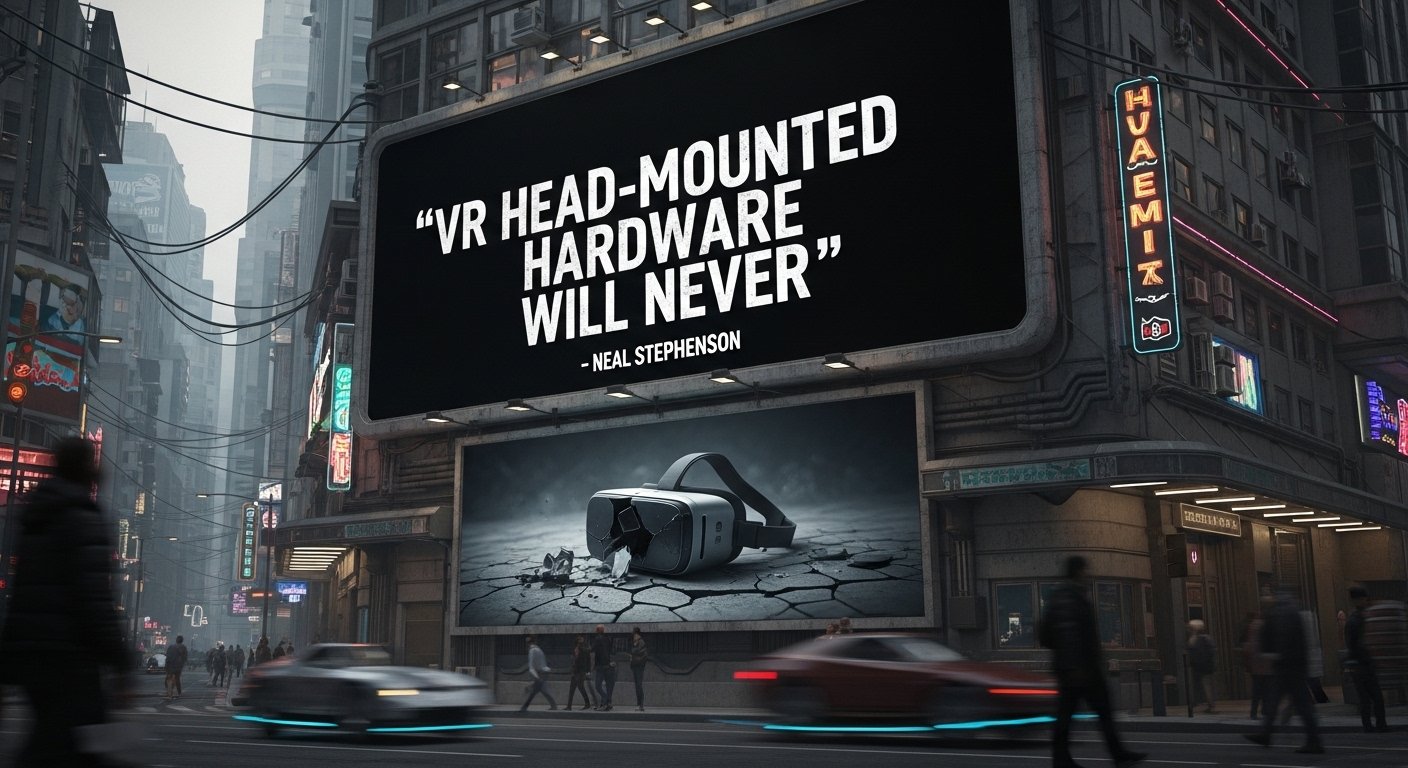
When the man who coined the term ‘metaverse’ says something bold about virtual reality, the tech world listens. Neal Stephenson, the visionary science fiction author behind Snow Crash, has made a striking claim: head-mounted VR hardware will never happen as a mainstream consumer technology. For a writer whose 1992 novel essentially blueprinted the digital universe that Silicon Valley has been chasing ever since, this is not a casual opinion — it is a considered, experience-backed verdict. In an era where companies like Meta, Apple, and Sony have collectively invested hundreds of billions of dollars into head-worn devices, Stephenson’s skepticism cuts through the hype with surgical precision.
Stephenson’s position challenges the dominant narrative in immersive technology development. While tech giants continue racing to perfect VR headset design, shrink form factors, and improve display resolution, the author argues the fundamental concept of strapping a device to a human head is fundamentally flawed. His reasoning goes beyond comfort or style — it touches on deep human psychology, social behavior, and the practical realities of how people interact with the world around them. This article unpacks Stephenson’s argument, explores the context behind it, and examines what the future of the metaverse might actually look like — if not through a headset.
Who Is Neal Stephenson and Why Does His Opinion on the Metaverse Matter?
Before diving into the substance of Stephenson’s claims, it is worth understanding exactly why his voice carries so much weight in these conversations. Most futurists predict the trajectory of technology by analyzing trends, patents, and investment data. Stephenson, by contrast, imagined the metaverse before the internet was widely available to ordinary people. In Snow Crash, published in 1992, he described a vast, immersive digital world called the Metaverse — a persistent shared virtual space accessed by avatars — with breathtaking specificity.
Decades later, Mark Zuckerberg renamed his company Meta, explicitly acknowledging the influence of Stephenson’s vision. Venture capitalists began throwing the word ‘metaverse’ into pitch decks. Entire industry conferences emerged around the concept. Stephenson’s fictional creation became a trillion-dollar investment thesis. So when the man who dreamed it all up steps back and questions one of the most central assumptions of that thesis — that humans will wear head-mounted VR hardware to access these virtual worlds — it demands serious attention.
Stephenson is not an armchair commentator. He served as Chief Futurist at Magic Leap, one of the most ambitious and heavily funded augmented reality hardware companies in history. He has worked alongside engineers, product designers, and neuroscientists trying to solve the very problem he now says is unsolvable. His conclusion, therefore, is not pessimism — it is informed realism.
Neal Stephenson VR Head-Mounted Hardware: The Core Argument
The heart of Stephenson’s position is deceptively simple: human beings are not wired to wear things on their faces for extended periods of time. Unlike smartphones, which slipped seamlessly into existing pocket-carrying behavior, or earbuds, which replaced a device people were already wearing (headphones), VR headsets require a fundamentally unnatural behavior. People do not habitually cover their eyes and ears with a sealed device while going about their daily lives.
Stephenson has pointed out that the barrier is not purely technical. Yes, issues like the vergence-accommodation conflict (the mismatch between where your eyes focus and where 3D images appear to originate) create physiological discomfort. Yes, current VR hardware remains bulky, hot, and prone to causing motion sickness in a significant percentage of users. But even if engineers solved all of those problems tomorrow, Stephenson argues, people still would not strap boxes to their faces for work, social interaction, or entertainment at any meaningful scale.
The Social Isolation Problem with Head-Mounted VR Devices
One of the most compelling points in Stephenson’s critique involves social isolation. When you put on a VR headset, you become visually and aurally cut off from the physical world around you. You cannot see your spouse walking into the room, your child needing attention, or a colleague approaching your desk. You cannot read facial expressions or pick up on body language from people in your physical environment.
This is not merely inconvenient — it is psychologically and socially untenable for the kind of extended, daily use that tech companies envision. Stephenson has noted that even at Magic Leap, despite working with brilliant engineers and having enormous resources, the team could not fully escape this core contradiction. Any device that seals off the wearer from their physical surroundings will always face an insurmountable adoption ceiling.
Lessons from the History of Wearable Technology Failures
History supports Stephenson’s skepticism. Google Glass launched to enormous fanfare in 2013 and became a cautionary tale within two years. The device was thinner and lighter than any VR headset, yet users found it socially awkward, invasive, and impractical. Microsoft’s HoloLens, despite being technically impressive, remained confined to enterprise niche applications. Magic Leap itself burned through over two billion dollars in venture capital before pivoting away from its consumer ambitions.
Even Apple’s Vision Pro, arguably the most sophisticated spatial computing device ever released to the public, has struggled to find mainstream adoption. At a starting price above three thousand dollars and with a form factor that still isolates the wearer from their environment, the device has remained a product for early adopters and enterprise buyers rather than the mass-market revolution Apple suggested it would become.
What Neal Stephenson Envisions Instead of VR Head-Mounted Hardware
If Stephenson is so skeptical of head-mounted VR hardware, the natural question is: what does he think the future of immersive computing actually looks like? His answer is nuanced and, perhaps surprisingly, not a rejection of immersive technology altogether. Rather, Stephenson believes the future lies in ambient and environmental computing — where digital information and experiences are layered onto the physical world through means that do not require isolating the user.
He has spoken about the potential of technologies that blend the digital and physical in ways that feel natural rather than intrusive. Smart contact lenses, for instance, represent one direction that researchers are actively exploring — a form factor so unobtrusive that it mimics normal vision while overlaying information. Similarly, advances in projection mapping, haptic feedback systems, and spatial audio could collectively create rich, immersive environments without requiring users to strap anything to their faces.
The Role of AI in Shaping the Future Metaverse
Stephenson is also deeply interested in the role of artificial intelligence in shaping whatever digital universe eventually emerges. He has suggested that AI-driven environments — responsive, adaptive spaces that learn from and respond to individual users — may be far more significant than the hardware debate. The question of how we access the metaverse matters less than what that metaverse is capable of doing.
This is an important distinction. The tech industry has spent enormous energy debating form factors — headsets vs. glasses vs. phones — while arguably underinvesting in the content, social structures, and economic systems that would make a persistent virtual world genuinely compelling and useful. Stephenson, whose Snow Crash metaverse was deeply concerned with the social and cultural dimensions of virtual life, has always cared more about the human experience inside these worlds than the mechanical means of entering them.
How the VR and Tech Industry Has Responded to Stephenson’s Skepticism
Predictably, not everyone in the virtual reality industry agrees with Stephenson’s assessment. Meta’s engineers have consistently argued that display and optics technology is on a trajectory that will eventually produce headsets thin enough to resemble conventional eyeglasses. The company’s research labs have demonstrated prototype displays that compress the optics of a VR headset into a form factor closer to sunglasses than ski goggles.
Others point to the precedent of smartphones. When Apple introduced the first iPhone in 2007, skeptics argued that people would never type on glass, that the battery life was inadequate, and that the camera was a gimmick. Technological adoption curves often defy early critics, and VR proponents argue that Stephenson’s skepticism may simply be premature.
But Stephenson’s counter-argument is that the smartphone analogy does not hold. Smartphones augmented and accelerated existing behaviors — talking, messaging, photography, navigation. Head-mounted VR devices do not augment existing daily behaviors; they replace them entirely with an isolated digital experience. That is a fundamentally different proposition, and one that faces a far steeper behavioral adoption curve regardless of how good the hardware becomes.
Enterprise VR: The One Domain Where Head-Mounted Hardware Survives
Stephenson does acknowledge that enterprise and professional VR applications represent a genuinely viable use case for head-mounted hardware. In scenarios where the user is already stationary and isolated — a surgeon rehearsing a procedure, a pilot training in a flight simulator, an architect walking through a building that does not yet exist — the immersive isolation of VR becomes a feature rather than a bug.
What he disputes is the vision of consumer VR hardware as a daily-use device for billions of people. The mass-market metaverse that tech companies have envisioned — where people socialize, shop, work, and play through head-mounted displays — is, in Stephenson’s view, a fundamental misreading of human behavior and social psychology.
What Stephenson’s VR Prediction Means for the Future of the Metaverse
If Stephenson is right — and his track record of visionary accuracy gives his opinions unusual weight — the implications for the tech industry are profound. Billions of dollars currently being invested in consumer VR headset development may be chasing a dead end. Companies that have staked their future strategies on head-mounted hardware may need to fundamentally reconsider their roadmaps.
For consumers, Stephenson’s argument is actually liberating. It suggests that the truly exciting developments in immersive technology may not require buying expensive, heavy, and socially awkward hardware at all. The future he envisions is one where the digital world meets us where we are, rather than requiring us to retreat into an isolated headset to meet it.
This vision is also more inclusive. Accessible immersive technology — the kind that does not require purchasing a device costing thousands of dollars and strapping it to your face — is technology that can reach the billions of people who have smartphones but cannot afford or will not wear a VR headset. In this sense, Stephenson’s skepticism about head-mounted hardware is also implicitly an argument for a more democratized metaverse.
Conclusion
Neal Stephenson did not just predict the metaverse — he named it, defined it, and described it in enough operational detail that engineers have been building from his blueprint for thirty years. When he says that VR head-mounted hardware will never achieve mainstream consumer adoption, the tech industry would do well to listen carefully rather than dismiss the claim as the contrarianism of an outsider.
His argument is not anti-technology. It is pro-human. Technology succeeds when it works with the grain of human behavior, not against it. Head-mounted VR hardware asks users to isolate themselves from their physical world, their social circles, and their own instinctive comfort. That is a very high ask — and no amount of engineering refinement changes the fundamental nature of that ask.
Whether you agree with Stephenson or believe that VR hardware innovation will eventually overcome these barriers, his perspective should reshape how the industry thinks about the metaverse and its future. The question worth asking is not “How do we make better headsets?” but “How do we create immersive digital experiences that fit naturally into human life?”
If you’re building, investing in, or simply following the evolution of immersive technology, now is the time to re-examine your assumptions about VR head-mounted hardware and consider what a truly human-centered metaverse might look like. Revisit Stephenson’s Snow Crash with fresh eyes — the answers may have been there all along.
See more;What Is Metaverse A Plain-English Guide To The Next Internet
