

If you have spent any time following financial news, tech trends, or the rise of cryptocurrencies, chances are you have encountered the phrase blockchain technology. But despite its widespread mention in mainstream media, many people still struggle to understand what it actually is and why it matters. Blockchain technology is a revolutionary method of recording and sharing data across a network of computers in a way that is transparent, secure, and tamper-resistant. It is the backbone of digital currencies like Bitcoin and Ethereum, yet its potential stretches far beyond finance — into healthcare, supply chains, voting systems, and more.
Understanding how blockchain technology works is no longer just a skill for developers or investors. It is rapidly becoming essential knowledge for anyone who wants to navigate the digital economy. In this article, we break down everything you need to know — from the foundational concepts to real-world use cases — in plain, accessible language.
What Is Blockchain Technology?
At its core, blockchain technology is a type of distributed ledger technology (DLT) that stores data in a chain of blocks. Each block contains a set of records — such as financial transactions or contractual agreements — and once a block is added to the chain, the information inside it cannot be altered without changing every subsequent block. This immutability is what makes blockchain so powerful as a trust mechanism.
Unlike a traditional database controlled by a single company or government, a decentralized blockchain network is maintained by thousands of computers — called nodes — spread across the globe. There is no single point of failure, no central authority that can manipulate the records, and no need for a third-party intermediary to validate transactions. The network itself acts as the referee.
The Building Blocks: What Goes Inside a Block?
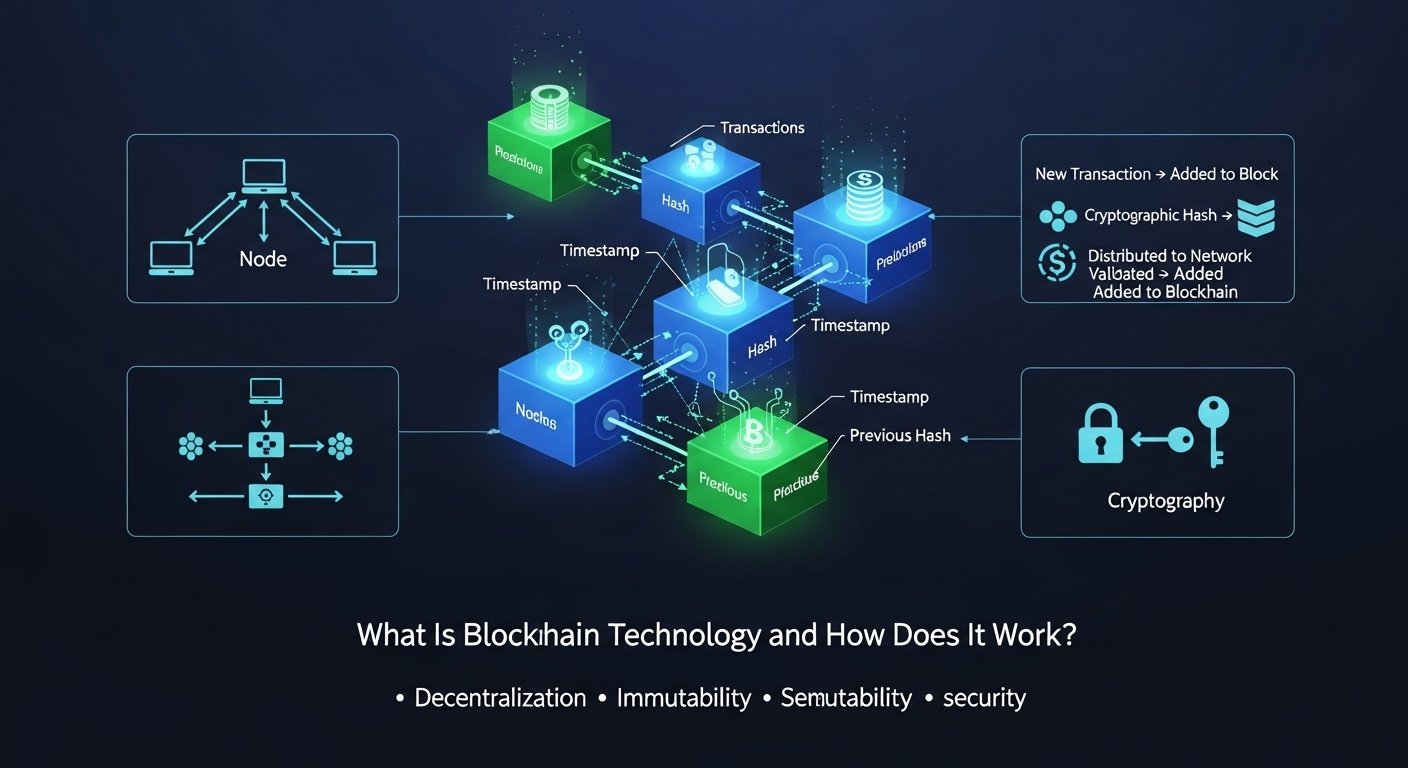
Each block in a blockchain typically contains three key components. First is the data — the actual content of the transaction or record, such as who sent funds, who received them, and the amount involved. Second is the hash — a unique cryptographic fingerprint that identifies the block and its contents, much like a digital signature. Third is the previous block’s hash, which links the current block to its predecessor and creates the unbreakable chain structure.
This linking mechanism is precisely what makes tampering nearly impossible. If someone tries to alter a block, the hash of that block changes, which in turn breaks the link to the next block, and the next, all the way down the chain. The network immediately detects the inconsistency and rejects the tampered version.
How Does Blockchain Technology Work?
Now that we know what it is, the natural follow-up question is: how does blockchain technology actually work? .
The Step-by-Step Transaction Process
When a user initiates a transaction — say, sending cryptocurrency to another person — that transaction is first broadcast to the peer-to-peer network of nodes. Each node receives this request and begins the validation process. The nodes use a consensus mechanism — either Proof of Work or Proof of Stake — to agree on whether the transaction is legitimate.
Once verified, the transaction is grouped with other pending transactions to form a new block. That block is then given a cryptographic hash and added to the existing chain in a permanent, chronological order. From this point on, the record is immutable. Every node in the network updates its own copy of the ledger to reflect the change, and the transaction is complete — usually within seconds to minutes, depending on the network.
Understanding Consensus Mechanisms in Blockchain
The consensus mechanism is the engine that keeps a decentralized blockchain network honest. Without a central authority to decide what is true, the network must find another way to agree. The two most prevalent mechanisms are Proof of Work (PoW) and Proof of Stake (PoS).
In Proof of Work, nodes — known as miners — compete to solve complex mathematical puzzles. The first to solve the puzzle earns the right to add the next block and receives a reward. While this method is incredibly secure, it is also energy-intensive, which has drawn criticism in recent years. Proof of Stake, used by networks like Ethereum after its 2022 upgrade, selects validators based on how much cryptocurrency they “stake” as collateral. This approach is far more energy-efficient while maintaining strong security guarantees.
Key Characteristics That Define Blockchain Technology
What sets blockchain technology apart from conventional data storage is not just one feature but a combination of properties that work together to create a trustworthy, resilient system.
Decentralization and Transparency
Traditional databases are centralized — a bank owns its transaction records, and a government controls voter data. Blockchain’s decentralized architecture means no single entity owns the data. Every participant on the network holds an identical copy of the ledger, and any changes are visible to all. This radical transparency is especially valuable in financial systems, where trust has historically depended on intermediaries like banks.
Immutability and Security
Once data is written onto a blockchain, it is permanent. This immutability makes blockchain an ideal foundation for systems where an audit trail is critical — think land registries, medical records, or supply chain logs. Combined with public-key cryptography, which protects individual user identities, blockchain creates a system that is both transparent and private simultaneously.
Smart Contracts: Automation on the Blockchain
One of the most transformative innovations built on top of blockchain technology is the smart contract — a self-executing program stored on the blockchain that automatically carries out the terms of an agreement when predefined conditions are met. Introduced by the Ethereum platform, smart contracts eliminate the need for lawyers, notaries, or escrow services in many types of agreements.
For example, a smart contract in real estate could automatically transfer property ownership and release funds the moment all legal conditions are verified — with no paperwork, no waiting for banks to open, and no risk of one party backing out. This capability has sparked entire new industries, including decentralized finance (DeFi) and non-fungible tokens (NFTs)
Types of Blockchain Networks You Should Know
Not all blockchain networks are created equal. Depending on the use case, organizations choose between several distinct types:
Public blockchains, like Bitcoin and Ethereum, are open to anyone. Anyone can read the data, participate in the consensus process, and submit transactions. These are the most decentralized and transparent but can be slower due to scale. Companies like IBM use private blockchains for internal logistics and supply chain management.
Consortium blockchains are governed by a group of organizations rather than a single entity. They are popular in industries like banking and healthcare, where multiple stakeholders need to share data securely without giving any one party complete control.
Hybrid blockchains combine elements of both public and private models, allowing organizations to keep sensitive data private while making other records publicly verifiable.
Real-World Applications of Blockchain Technology
The real-world impact of blockchain technology is already being felt across numerous industries, demonstrating that its value extends well beyond digital currencies.
In finance and banking, blockchain enables near-instant cross-border payments without correspondent banks, dramatically reducing fees and settlement times. Companies like Ripple are already facilitating billions of dollars in international transfers using distributed ledger technology
In supply chain management, giants like Walmart and Maersk use blockchain to track products from origin to shelf in real time. When a food safety issue arises, what once took days of paperwork to trace can now be resolved in seconds using an immutable blockchain record. This eliminates duplicate testing, reduces medical errors, and gives patients control over their own health data.
In voting systems, blockchain-based platforms promise tamper-proof elections where each vote is recorded as an immutable transaction, verifiable by the public yet anonymous for the voter. Pilot programs have already been tested in several countries.
Advantages and Limitations of Blockchain Technology
Like any technology, blockchain comes with both significant strengths and real challenges that organizations must weigh carefully.
The advantages are substantial. Enhanced security through cryptographic hashing and decentralization makes it extraordinarily difficult to hack or manipulate. Increased transparency builds trust between parties who may not know each other. Reduced costs come from removing intermediaries. And improved traceability creates accountability in complex multi-party systems.
However, challenges remain. Scalability is a persistent issue — public blockchains like Bitcoin can process only a handful of transactions per second compared to thousands for centralized payment networks. Energy consumption for Proof of Work systems is enormous. Regulatory uncertainty continues to create friction for enterprise adoption. And the complexity of implementation means that organizations need specialized knowledge to deploy blockchain solutions effectively.
The Future of Blockchain Technology in a Digital World
The trajectory of blockchain technology points toward deeper integration with other emerging technologies. Governments worldwide are exploring Central Bank Digital Currencies (CBDCs) built on blockchain infrastructure. The European Union, China, and more than 100 other nations are at various stages of developing their own digital currencies.
Ethereum’s continued evolution, the growth of Layer 2 scaling solutions like Polygon and Arbitrum, and the increasing adoption of zero-knowledge proofs for privacy are all signals that blockchain technology is far from reaching its ceiling. What we see today is, in many ways, just the foundation.
Conclusion: Why Blockchain Technology Matters Now More Than Ever
Blockchain technology represents one of the most significant innovations in how humanity stores, shares, and trusts information. From its foundational structure of cryptographically linked blocks to its expansive real-world applications in finance, healthcare, and governance, blockchain is actively reshaping the digital landscape.
Understanding what blockchain technology is and how it works gives you a critical advantage — whether you are a business leader evaluating new infrastructure, a developer building decentralized applications, or simply a curious individual who wants to make sense of a rapidly changing world. The technology is not a distant future concept; it is operating at scale, right now, across industries and borders.
If you are ready to go deeper, start by exploring a public blockchain explorer like Etherscan, try setting up a simple crypto wallet, or read the original Bitcoin whitepaper by Satoshi Nakamoto. The best way to truly understand blockchain technology is to interact with it directly. Take the first step today — the decentralized future is already here, and it is waiting for you to participate.
See more;Invest in Blockchain Technology Stocks Complete Guide 2025
