

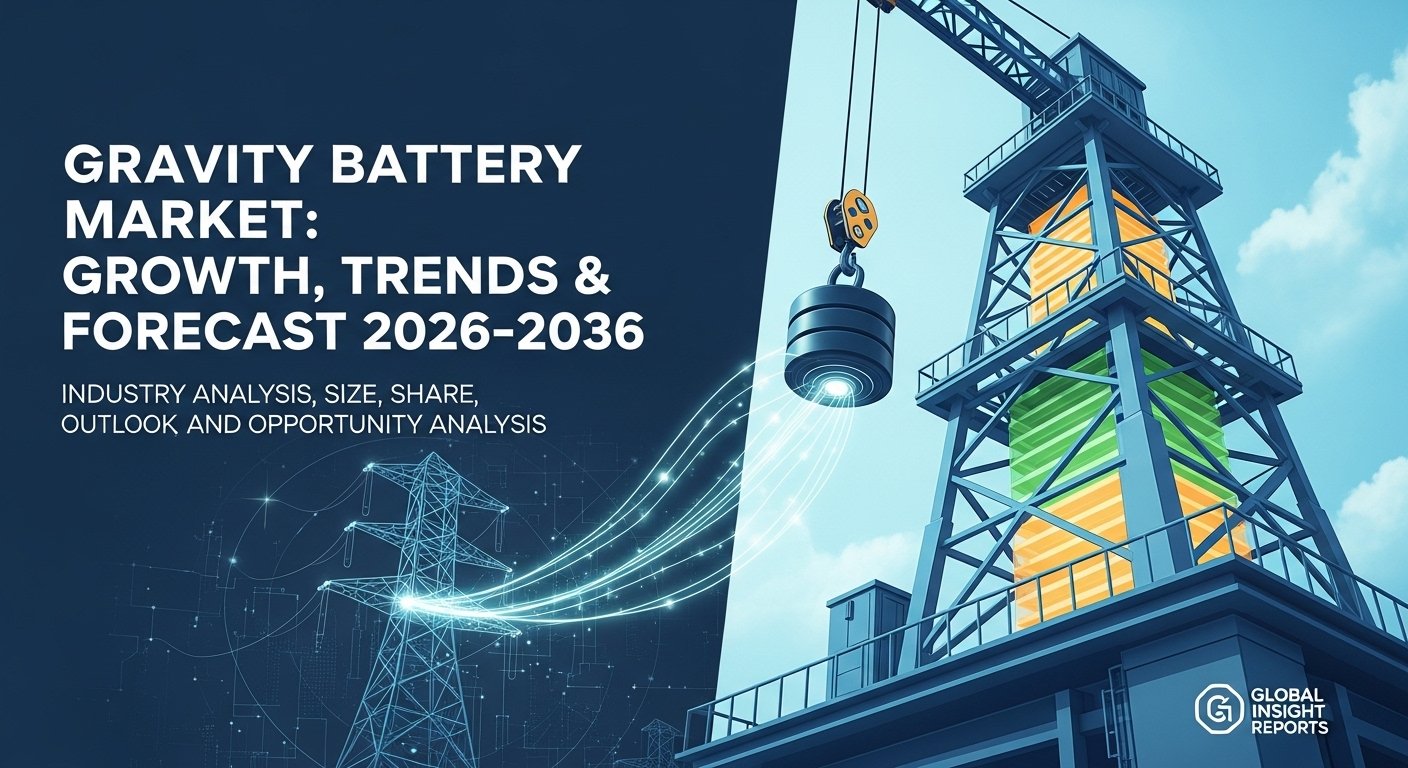
The global gravity battery market is entering one of its most transformative decades. As the world accelerates its transition away from fossil fuels, the demand for reliable, long-duration, and cost-effective energy storage has never been more urgent. Unlike lithium-ion batteries that rely on chemical reactions, gravity-based energy storage systems harness one of the most fundamental forces in nature — gravitational potential energy — to store and dispatch electricity at scale. From 2026 through 2036, this market is projected to expand dramatically, driven by renewable energy integration, falling technology costs, and a growing global push toward carbon neutrality.
Gravity batteries work by lifting heavy masses — such as concrete blocks, repurposed mine shafts, or suspended weights in tall towers — during periods of excess electricity generation, then releasing that stored energy by allowing the masses to descend. The simplicity of the mechanism, combined with long operational lifespans and minimal environmental impact, makes this technology an increasingly attractive alternative to conventional grid-scale energy storage solutions. As renewable energy capacity surges worldwide, the gravity battery market stands at the frontier of the clean energy transition.
Gravity Battery Market Overview: Setting the Stage for 2026
The gravity battery market was still in a nascent but rapidly evolving stage heading into 2026. Early commercial pilots — including tower-based gravity storage systems and underground elevator-style solutions in decommissioned mines — demonstrated that the technology could deliver multi-hour discharge at competitive costs. Market analysts broadly agree that the sector is transitioning from proof-of-concept into early commercial deployment, with several utility-scale projects now operating across Europe, Asia, and North America.
According to market intelligence reports, the global gravity energy storage sector was valued at approximately USD 400–600 million in 2025. Over the next decade, it is expected to surpass USD 5 billion, registering a compound annual growth rate (CAGR) in the range of 20–28%. This exceptional growth trajectory is underpinned by favorable government policies, massive investments in long-duration energy storage, and the urgent need to balance electricity grids as intermittent solar and wind power account for an ever-growing share of generation.
Key Growth Drivers of the Gravity Battery Market (2026–2036)
Several powerful forces are converging to propel the gravity battery market through the next decade. Understanding these drivers is essential for investors, policymakers, and energy system planners who aim to position themselves ahead of the curve.
Accelerating Renewable Energy Deployment
The single most important catalyst for gravitational potential energy storage growth is the explosive expansion of solar and wind power. The International Energy Agency (IEA) projects that renewable energy will account for over 60% of global electricity generation by 2035. However, the intermittent nature of these sources creates a critical mismatch between supply and demand — a gap that only robust storage technologies can bridge. Gravity batteries, capable of storing energy for 4 to 12 hours or more, are uniquely suited to address this challenge. As countries race to meet their net-zero commitments, demand for long-duration energy storage solutions is accelerating at an unprecedented pace.
Favorable Policy and Regulatory Environment
Governments worldwide are implementing policies that directly benefit the gravity battery market. The United States Inflation Reduction Act (IRA), the European Union’s REPowerEU initiative, and China’s 14th Five-Year Plan all include substantial provisions for energy storage investment tax credits, capacity payments, and technology mandates. Dedicated long-duration storage programs — such as the U.S. Department of Energy’s LDES (Long Duration Energy Storage) program — have allocated billions of dollars in grants and loan guarantees that are actively funding gravity storage demonstrations and early commercial projects.
Competitive Cost Profile Versus Chemical Batteries
One of the most compelling attributes of mechanical energy storage technologies like gravity systems is their favorable long-term cost profile. While lithium-ion batteries remain cheaper on a per-kWh basis for short-duration storage, their economics deteriorate significantly for durations beyond four hours. Gravity batteries, by contrast, exhibit near-linear cost scaling with storage duration, making them cost-competitive — or even superior — for 6 to 24-hour applications. As energy storage technology matures and project volumes increase, the levelized cost of storage (LCOS) for gravity systems is expected to fall below USD 0.10/kWh by the early 2030s, a threshold that will unlock massive market expansion.
Technology Landscape: Innovations Shaping Gravity Energy Storage
The gravity battery market encompasses a diverse and rapidly evolving set of technology platforms. Each approach applies the same fundamental physics — storing energy as gravitational potential — but through distinct mechanical architectures that offer different trade-offs in terms of cost, scalability, site requirements, and round-trip efficiency.
Tower-Based Gravity Storage Systems
Companies such as Energy Vault have pioneered tower-based approaches, where cranes lift and lower large composite blocks — often made from recycled materials — to store and release energy. These systems can be deployed in a wide range of locations and offer round-trip efficiencies in the range of 75–80%. The modular nature of tower systems makes them particularly attractive for distributed renewable energy storage systems, and several multi-hundred MWh projects are already under construction globally as of 2026.
Underground Shaft and Mine-Based Systems
Another rapidly scaling approach involves deploying gravity storage in underground shafts or decommissioned mine infrastructure. This approach dramatically reduces capital expenditure and leverages the enormous installed base of mines worldwide, many of which are located close to renewable energy generation sites.
Rail and Slope-Based Systems
A third category of gravitational potential energy storage uses heavy trains or cars on sloped railway tracks to store and generate electricity. ARES (Advanced Rail Energy Storage) in the United States has demonstrated this concept in utility-scale pilots. The appeal of rail-based systems lies in their relatively low construction costs when suitable terrain is available and their compatibility with existing rail infrastructure and supply chains.
Competitive Landscape of the Gravity Battery Market
The gravity battery market currently features a mix of venture-backed startups, established engineering conglomerates, and utilities exploring proprietary solutions. The competitive environment is intensifying as proof-of-concept projects mature into commercial offerings.
Energy Vault (NYSE: NRGV) remains one of the most visible players, having secured partnerships with utilities in the United States, Saudi Arabia, and India. Gravitricity continues to advance its mine-shaft technology across Africa and Eastern Europe, where decommissioned coal mines present an enormous untapped opportunity. Green Gravity is making strong inroads across Australia’s rapidly decarbonizing energy grid. Meanwhile, major infrastructure companies like ABB and Siemens Energy are developing partnership strategies and component supply chains to serve the growing grid-scale energy storage segment.
Investment activity in the gravity battery market has surged, with total venture and project finance inflows exceeding USD 2 billion between 2023 and 2025. Strategic investments from oil majors like Shell and BP — seeking to diversify into clean energy transition technologies — are also accelerating commercialization timelines.
Regional Outlook: Where the Gravity Battery Market Is Growing Fastest
Europe: Policy-Led Early Adoption
Europe leads the world in early-stage deployment of gravity energy storage, driven by the EU’s aggressive 2030 and 2050 climate targets and a supportive regulatory framework. The United Kingdom’s abundant decommissioned mine infrastructure and Scotland’s strong wind resources create particularly favorable conditions for gravity storage deployment. Germany and Spain are also actively funding storage pilots as they phase out nuclear and coal generation.
Asia-Pacific: Volume Growth Engine
The Asia-Pacific region — led by China, India, and Australia — is expected to become the largest market for gravity battery technology by the early 2030s in terms of installed capacity. China’s aggressive long-duration energy storage targets under its national energy plan call for over 30 GW of non-pumped-hydro storage by 2030, creating enormous demand for commercial gravity systems. India’s rapidly expanding renewable energy sector and Australia’s grid stability challenges provide additional growth vectors.
North America: Policy Tailwinds and Project Pipeline
In North America, the IRA has supercharged investment in the gravity battery market. Several large-scale projects are in advanced development across the western United States, where rugged terrain provides natural opportunities for rail and slope-based systems. Canada’s mine-rich provinces offer similar opportunities for underground shaft-based approaches.
Challenges Facing the Gravity Battery Market Through 2036
Despite its strong growth outlook, the gravity battery market faces real challenges that could slow its trajectory. Site specificity is perhaps the most significant constraint: unlike chemical batteries, gravity systems are heavily dependent on local geography, available land, or existing mine infrastructure. Round-trip efficiency — typically 75–85% for most gravity systems compared to 85–95% for lithium-ion — remains a point of competitive weakness. Engineering advances are progressively closing this gap, but it remains a consideration in markets where electricity prices are high. Supply chain development for the specialized mechanical components used in mechanical energy storage systems is another area requiring sustained investment. Finally, permitting and land-use approvals for large infrastructure projects can introduce significant delays, particularly in densely populated European markets.
Future Outlook: Gravity Battery Market Forecast to 2036
Looking ahead to 2036, the gravity battery market is poised for exceptional growth across every major dimension — installed capacity, revenue, and geographic reach. Analysts forecast that total installed gravity storage capacity could reach 15–25 GW globally by 2036, up from less than 1 GW today.
Technological convergence will play a key role in shaping the market. Hybrid systems combining gravity storage with short-duration battery storage are emerging as powerful solutions that can provide both frequency regulation and multi-hour dispatch. Advanced AI-powered control systems are also enabling gravity energy storage assets to participate more effectively in wholesale electricity markets, improving project economics and accelerating payback periods.
The intersection of the gravity battery market with the broader energy storage technology 2026 ecosystem — including hydrogen, pumped hydro, and compressed air — will define the long-duration storage landscape of the 2030s.
🔍 Related Search Terms (Google First-Page Intent)
gravity battery market size 2026 | gravity energy storage companies | long-duration energy storage market | gravity battery vs lithium ion | gravitational energy storage technology | grid scale energy storage forecast | gravity battery investment | mechanical energy storage systems | clean energy storage solutions | energy storage market trends 2026 | gravity battery market share | renewable energy storage market | gravity storage LCOE | energy vault gravity battery | best long duration energy storage technology
Conclusion: Why the Gravity Battery Market Demands Your Attention Now
The gravity battery market represents one of the most compelling investment and policy opportunities of the coming decade.
For investors, utilities, policymakers, and energy system designers, the window of maximum strategic opportunity in the gravity battery market is open right now. Early movers — whether selecting technology platforms, establishing supply chains, or developing project pipelines — stand to capture disproportionate value as the market scales through 2036 and beyond.
Ready to explore the gravity battery market further? Download our full 2026–2036 market intelligence report, or contact our research team today to discuss custom analysis, investment screening, or technology benchmarking services tailored to your organization’s needs. The energy transition is accelerating — make sure gravity energy storage is part of your strategy.
See more;Bitcoin Dominance Wanes: Institutional Investors Turn to Altcoins
