

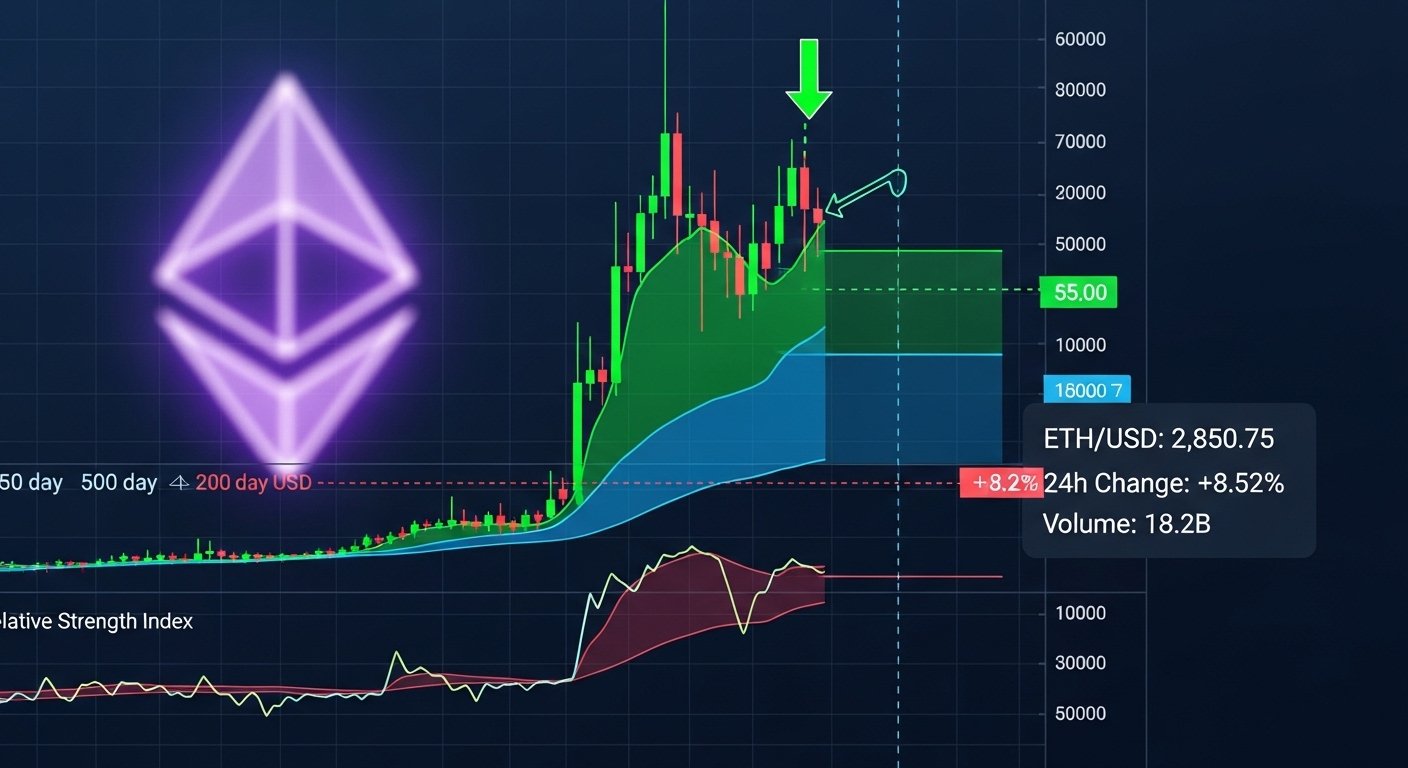
The crypto market is buzzing again, and every trader’s eyes are locked on one question: how far can Ethereum actually run? A serious Ethereum price bounce analysis is exactly what the market needs right now. After weeks of compression and sideways action, ETH has started to show signs of life — but the real question is whether this is a genuine breakout or just another relief rally destined to fade. With $BTC setting the macro tone and $BNB quietly accumulating, the broader altcoin environment is becoming increasingly constructive. For ETH bulls and bears alike, understanding the structure of this bounce is critical before making any major trading decisions.
In this deep-dive, we break down the key technical levels, on-chain signals, and market context that will determine how high this Ethereum bounce can realistically go. Current Ethereum Market Structure: Reading the Chart
Before diving into price targets, it’s essential to understand where Ethereum sits structurally. After the late 2024 correction that saw ETH shed a significant portion of its value from its local highs, the asset has been building what appears to be a higher low on the weekly chart. This is a foundational signal in any Ethereum technical analysis framework — higher lows indicate that selling pressure is drying up and buyers are stepping in at progressively stronger levels.
The ETH price structure on the daily chart is particularly telling. A series of consolidation candles near a key demand zone has formed what technical analysts would recognize as a compression pattern — often a precursor to an explosive directional move. Volume during this consolidation has been declining, which is generally bullish: it suggests that sellers are exhausted and the market is coiling before its next move.
What makes this setup even more interesting is the relationship between ETH and BTC dominance. Bitcoin has been slowly losing dominance over recent weeks, a classic indicator that capital is beginning to rotate into altcoins. Historically, whenever BTC dominance rolls over from a peak, Ethereum has been one of the first major beneficiaries, often surging 20–40% against Bitcoin in the weeks that follow.
Key Support Levels Holding Firm for ETH
Support is the foundation of any bullish thesis. For Ethereum, there are two primary support clusters that bulls must defend to keep the Ethereum price bounce narrative alive. The first major support sits at a zone that has been tested multiple times and has held on a closing basis. This is significant because markets remember price action — and repeated tests of support that hold tend to build conviction among buyers.
The second, deeper support zone represents the broader macro accumulation area that large institutional players have been eyeing. On-chain data shows substantial accumulation at this level, with wallet addresses holding over 1,000 ETH showing net inflows during previous dips. This kind of smart money accumulation is a powerful confirmation signal that the downside is limited in the near term.
Ethereum Price Bounce Analysis: The Resistance Levels That Matter
A comprehensive Ethereum price bounce analysis must account for the resistance levels that stand between current price and the targets bulls are eyeing. These are not arbitrary numbers — they represent zones where significant sell orders have historically been placed and where previous market participants who bought near the top are likely to exit their positions when they return to break-even.
The second critical resistance zone corresponds with a previous structural breakdown point. In technical analysis, this concept is known as a resistance-to-support flip — where a level that once acted as support, once broken, becomes resistance. For ETH to sustain a meaningful recovery, it must reclaim this level convincingly. A weak push into this zone followed by rejection would be a warning sign for traders looking to ride momentum.
Beyond these two levels, the path toward the next major target would open up if ETH can consolidate above resistance and establish it as new support. This is the bull case scenario — a textbook breakout-retest-continuation pattern that has played out multiple times in Ethereum’s history during strong crypto bull run periods.
Fibonacci Retracement Zones and ETH Price Targets
Fibonacci retracement levels are among the most reliable tools in a crypto trader’s arsenal, and Ethereum’s current move is textbook in how it respects these zones. Drawing from the last major swing high to the most recent swing low, the 0.618 Fibonacci level — often called the “golden ratio” retracement — aligns almost perfectly with the second major resistance described above. This confluence of technical signals significantly increases the probability that this level will be contested heavily.
If Ethereum powers through the 0.618 level with conviction, the 1.0 Fibonacci extension and the 1.618 extension levels become the next logical targets. These extensions are frequently used by institutional traders to set profit targets in trending markets, and their confluence with previous swing highs makes them particularly meaningful in any ETH price prediction model.
The Role of BTC and BNB in Ethereum’s Bounce Potential
No Ethereum price bounce analysis exists in isolation. The crypto market is deeply interconnected, and the behavior of Bitcoin ($BTC) and Binance Coin ($BNB) directly influences the conditions under which Ethereum can thrive. Understanding these relationships is crucial for any trader seeking to time entries and exits with precision.
Bitcoin remains the undisputed king of the crypto market. Its price action sets the risk-on/risk-off tone for the entire asset class. When BTC is in a period of low volatility and sideways price action — as it often is during accumulation phases — it creates a vacuum of opportunity for altcoins like Ethereum to outperform. This phenomenon, known colloquially as altcoin season, has historically been one of the most powerful and profitable periods for ETH holders.
BNB, meanwhile, serves as a useful proxy for the health of the broader Binance ecosystem and the appetite for risk among retail participants. When BNB is trending strongly, it often signals that retail traders are actively engaging with the market — and retail participation tends to amplify moves across the board, including for Ethereum. The BNB trend is therefore an important leading indicator to watch alongside any ETH technical analysis
ETH/BTC Ratio: The Most Important Chart in Altcoin Season
Beyond USD-denominated price charts, savvy traders watch the ETH/BTC ratio closely to gauge relative strength. A rising ETH/BTC ratio means Ethereum is outperforming Bitcoin on a percentage basis, which is a strong signal of altcoin confidence.
Currently, the ETH/BTC ratio is sitting at a historically interesting level. If the ratio can break above its current compression zone, it would be a powerful technical confirmation that the Ethereum price bounce has legs — and that the market is genuinely rotating into ETH rather than simply moving in lockstep with Bitcoin.
On-Chain Data Supporting the Ethereum Bounce Thesis
Technical analysis tells one part of the story, but on-chain data tells another — and often more honest — story about what market participants are actually doing with their coins. For Ethereum, the on-chain picture is increasingly constructive and aligns well with the technical setup described above.
Exchange outflows are one of the most important metrics to watch. When large amounts of ETH leave centralized exchanges, it suggests that holders are moving their coins into self-custody — typically a sign that they intend to hold rather than sell. Recent data shows sustained exchange outflows, reducing the available liquid supply and tightening the market in a way that can amplify price moves to the upside when demand increases.
The ETH staking rate is another critical on-chain metric. This supply-side tightening, combined with demand from institutional crypto investment and growing DeFi activity, creates a compelling supply-demand dynamic that is fundamentally bullish for ETH price over time.
Network Activity and Gas Fees as Sentiment Indicators
Network activity is a real-time pulse check on Ethereum’s utility and adoption. During periods of high network activity, the ETH burn mechanism introduced by EIP-1559 also accelerates, reducing net issuance and creating deflationary pressure.
When these on-chain signals align with bullish technical setups, the probability of a sustained Ethereum crypto rally increases substantially. The convergence of supply tightening, smart money accumulation, and a technically sound chart is precisely the kind of setup that experienced traders look for when sizing into high-conviction positions.
Realistic Price Targets: How High Can the Ethereum Bounce Go?
This is the question every investor is asking — and the honest answer requires distinguishing between the bull, base, and bear case scenarios. A responsible Ethereum price bounce analysis must account for multiple outcomes rather than cherry-picking only the most optimistic projections.
In the base case scenario, Ethereum rallies into the first major resistance zone and consolidates. This would represent a solid but unremarkable recovery — enough to shake out late shorts and reward patient accumulation, but not enough to trigger the kind of euphoria that characterized previous cycle tops. In this scenario, ETH would likely trade sideways for a period before making its next decisive move.
The bull case scenario — which requires BTC to hold its levels and overall market risk appetite to remain elevated — sees Ethereum breaking above all major resistance levels and entering price discovery mode against the previous cycle’s structure. This would involve reclaiming the 200-day moving average, flipping the resistance-to-support level, and driving the ETH/BTC ratio to multi-month highs. In this scenario, the upside for ETH is substantial, and the rally could attract significant retail and institutional participation.
If Bitcoin experiences a sharp drawdown, or if macro risk-off conditions intensify, Ethereum could fail at resistance and retrace to test support. Risk management — including stop-losses and position sizing — remains non-negotiable regardless of how compelling the bullish thesis appears.
Trading Ethereum’s Bounce: Strategy and Risk Management
Understanding a market setup is only half the battle. Executing a trade around the Ethereum price bounce requires a disciplined approach to entries, targets, and risk. Here’s how experienced traders approach this kind of setup.
Entry timing is critical. Rather than chasing price into resistance, the smarter approach is to wait for a confirmed breakout above a key level before committing to a full position. A confirmed close above resistance, followed by a retest that holds as support, is the textbook entry signal.
Position sizing should reflect the inherent uncertainty of any crypto market rally. Even the most compelling setups fail regularly in crypto, and over-leveraging or over-concentrating in a single asset is a recipe for disaster. Spreading risk, using hard stops, and taking partial profits at each resistance level are all practices that separate consistent traders from those who blow up their accounts on a single trade.
The broader crypto market sentiment index (often referred to as the Fear & Greed Index) also deserves attention. Buying Conversely, chasing rallies when greed is extreme tends to lead to buying near local tops.
Conclusion
The Ethereum price bounce analysis paints an increasingly compelling picture for ETH bulls in the current cycle.
The market has a long history of humbling those who become too certain of any outcome. Now is the time to do your own research, map out your key levels, and develop a clear plan. Don’t wait for perfect conditions — perfect conditions don’t exist in markets.
See more;Bitcoin Price Today: Subdued Near 1-Month Low | Market Analysis
