

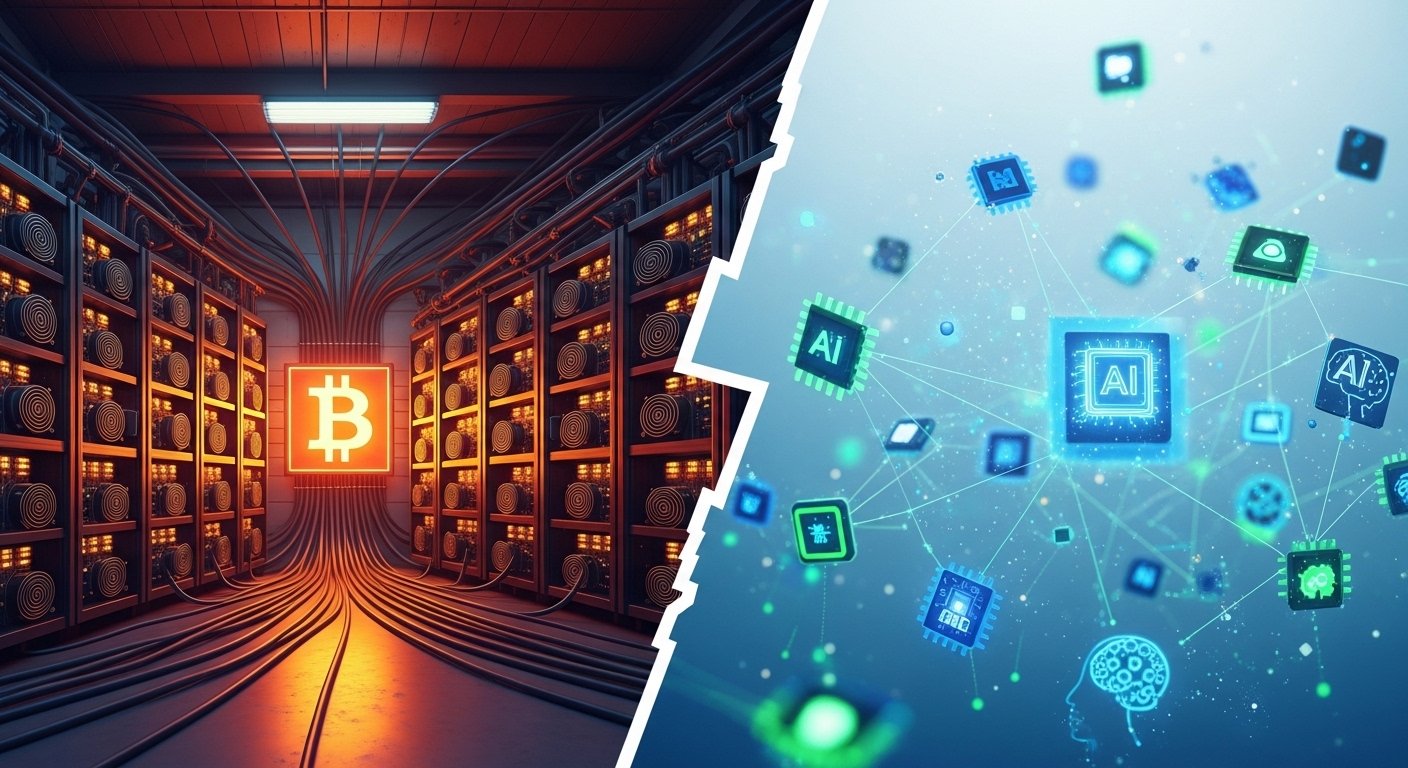
On one side, Bitcoin mining continues to consolidate power into the hands of a shrinking group of industrial players. On the other, artificial intelligence is racing toward an increasingly distributed, open, and democratized future. This contrast — that — has become one of the most compelling conversations in the technology and financial sectors. A growing chorus of experts is now raising the alarm about what this divergence means for the long-term integrity of digital economies and the open internet. Understanding why these two forces are moving in opposite directions is critical for investors, technologists, policymakers, and anyone with a stake in the future of decentralized systems.
What Is Bitcoin Mining Centralisation?
 At its core, Bitcoin was born from a radical idea: no single entity should control the network. Every miner, regardless of size, would have a proportional chance of validating transactions and earning block rewards. That founding vision, however, has faced serious erosion over the past decade.
Bitcoin mining centralisation refers to the growing concentration of computational power — measured as hash rate — in the hands of a small number of large mining pools, corporations, and nation-states. Rather than thousands of individual miners contributing equally, today’s Bitcoin network is largely dominated by a handful of industrial-scale operations. According to ongoing analysis from blockchain research firms, the top five mining pools consistently control more than 60% of the global hash rate at any given time.
This concentration has been driven by several compounding forces. The shift from CPU mining to GPU, then FPGA, and ultimately ASIC (Application-Specific Integrated Circuit) hardware dramatically raised the financial barrier to entry. Only well-funded operations could afford the latest, most efficient machines. Energy costs further tilted the playing field, rewarding miners with access to the cheapest electricity — typically found near hydroelectric dams in China, natural gas flares in the United States, or coal-fired grids in Kazakhstan.
The Role of Mining Pools in Crypto Mining Centralization
Mining pools were originally designed to smooth out the variance of mining rewards, allowing smaller participants to earn consistent income by pooling their hash rate. In practice, however, crypto mining centralization has accelerated because even within pools, governance and decision-making authority rests with pool operators. When a mining pool controls 30% or more of the network’s hash rate, it gains disproportionate influence over transaction ordering, fee structures, and potentially even the ability to execute a 51% attack — a scenario where a majority actor can rewrite recent transaction history.
The implications of blockchain power concentration extend well beyond theoretical attacks. It affects the credibility of Bitcoin’s decentralization narrative, a narrative that underpins much of its value proposition to institutional and retail investors alike.
Bitcoin Mining Centralisation Contrasts with AI Decentralisation: An Expert’s Perspective
The contrast becomes especially sharp when placed alongside the trajectory of artificial intelligence. Where Bitcoin’s mining infrastructure is collapsing inward, AI development is actively expanding outward. Experts in both fields have noted that this divergence is not accidental — it reflects fundamentally different incentive structures, technological architectures, and community philosophies.
Dr. Sarah Chen, a digital infrastructure analyst at a leading fintech research institute, recently summarized it clearly: “Bitcoin mining centralisation contrasts with AI decentralisation in ways that reveal the economic and technical pressures shaping each industry. Bitcoin’s proof-of-work mechanism rewards capital concentration, while AI’s open-source ecosystem rewards distributed collaboration.”
This observation aligns with what practitioners across both industries have been observing for years. The proof of work centralization problem in Bitcoin is structural — baked into the protocol’s design — whereas the decentralized AI movement is being actively driven by open-source communities, federated learning frameworks, and edge computing initiatives.
Why AI Is Moving Toward Distributed Infrastructure
Artificial intelligence, particularly large language models and machine learning pipelines, has historically been the domain of a few hyperscaler companies. Google, Microsoft, Meta, and Amazon controlled most of the training infrastructure. But the landscape shifted dramatically with the open-source AI explosion beginning in 2022 and accelerating through 2025 and 2026.
Distributed AI infrastructure is now a tangible reality. Projects like Hugging Face, EleutherAI, and a growing range of decentralized compute protocols are enabling researchers and developers worldwide to train, fine-tune, and deploy AI models without relying on centralized cloud providers. Federated learning — a technique where models are trained across many devices without centralizing data — is further enabling decentralized machine learning at scale.
The contrast with Bitcoin is instructive. While Bitcoin hash rate dominance continues to trend toward fewer, larger actors, AI compute is actively fragmenting toward more participants. The economic incentives differ: in AI, open-source collaboration produces network effects that benefit all participants, whereas in Bitcoin, each additional unit of hash rate is directly competitive with every other.
The Energy Question and Its Role in Mining Pool Concentration
One of the most powerful drivers of Bitcoin mining centralisation is energy economics. Industrial mining operations require access to electricity at a scale and cost that is simply unavailable to the average person. A single large mining facility can consume as much electricity as a small city, and its profitability depends on securing power purchase agreements that lock in rates far below retail prices.
This dynamic has produced a geographic concentration of mining activity that mirrors the mining pool concentration problem. When regulatory crackdowns occur — as they did in China in 2021 — hash rate does not democratize; it relocates to the next cheapest jurisdiction. The mining industry’s response to adversity is not to distribute, but to consolidate in new territories.
Crypto energy consumption remains a persistent point of criticism, and not just from environmental advocates. From a network security standpoint, energy-intensive mining concentrated in a few geographic regions creates geopolitical risk. A single government decision, a power grid failure, or a natural disaster in a key mining hub can meaningfully disrupt the global Bitcoin network.
Comparing AI Energy Use and Distributed Compute
AI model training is also energy-intensive, but the distribution of that energy use is rapidly evolving. Unlike Bitcoin mining — where geographic concentration of energy access drives blockchain power concentration — AI workloads can increasingly be split across heterogeneous hardware in multiple locations. Distributed AI infrastructure means that training runs can leverage idle GPUs on consumer hardware, university clusters, and regional data centers simultaneously.
This architectural flexibility is central to why AI decentralisation is achievable in ways that Bitcoin mining decentralisation currently is not. The AI ecosystem is not locked into a single competitive metric (hash rate) that rewards concentration. Instead, it benefits from diversity of hardware, geographic spread, and collaborative model development.
What This Divergence Means for the Future of Decentralized Systems
The fact that Bitcoin mining centralisation contrasts with AI decentralisation carries significant implications for the broader decentralization movement. Decentralization was supposed to be the defining promise of blockchain technology. Bitcoin was the proof of concept. Yet, paradoxically, it is AI — a technology born in the labs of large corporations — that is now more visibly embracing distributed development and open participation.
Decentralized AI networks such as Bittensor, Gensyn, and others are constructing economic frameworks that directly incentivize distributed compute contribution. These projects borrow the tokenomics logic of cryptocurrency while deliberately engineering against centralization pressure. Early data suggests they are succeeding in maintaining broader geographic and organizational distribution than Bitcoin’s mining ecosystem has managed.
For Bitcoin specifically, the path back toward genuine decentralization is unclear. Protocol-level changes that would reduce the hardware advantage of industrial miners — such as alternative proof-of-work algorithms or a shift to proof-of-stake — face enormous resistance from the very mining conglomerates that benefit most from the current structure. The Bitcoin hash rate dominance of large pools gives those actors significant political power within the community governance process.
Could AI Decentralisation Offer a Blueprint for Crypto?

Some technologists believe that the innovations driving decentralized machine learning could offer lessons for the Bitcoin ecosystem. Whether the Bitcoin development community has the will or the incentive to adopt such approaches remains an open question. What is clear is that the contrast between where Bitcoin mining is heading and where AI development is heading has become a defining fault line in the technology world.
Geopolitical Risks of Bitcoin Mining Centralisation
Beyond the technical and economic concerns, Bitcoin mining centralisation poses genuine geopolitical risks that experts are increasingly vocal about. A coordinated regulatory action by just a few governments could theoretically disrupt transaction processing for the world’s largest cryptocurrency.
This is not a hypothetical scenario. China’s 2021 mining ban demonstrated exactly how quickly crypto mining centralization can respond to government action — and how quickly the hash rate can re-concentrate elsewhere. The United States became a dominant mining jurisdiction almost overnight, raising its own set of questions about regulatory risk concentration.
Decentralized AI networks, by contrast, are inherently more resilient to such geopolitical pressure. The distributed nature of AI development provides a kind of geopolitical antifragility that Bitcoin’s mining infrastructure currently lacks.
Expert Predictions: Where Both Industries Are Headed
First, ASIC hardware efficiency continues to improve rapidly, meaning that mining profitability will continue to concentrate in operations that can afford the latest generation machines at scale. The economics of proof of work centralization are self-reinforcing.
Second, the open-source AI movement shows no signs of slowing. The proliferation of open-weight models, low-cost fine-tuning techniques, and accessible inference infrastructure means that AI computing distribution will continue to broaden. By 2027, analysts project that a majority of AI inference workloads globally will run on distributed or edge infrastructure rather than centralized hyperscaler clouds.
Third, regulatory pressure on crypto energy consumption and mining practices is intensifying in the European Union, the United States, and several emerging markets. This pressure is unlikely to decentralize mining — it is more likely to accelerate consolidation as smaller, less efficient operators exit the market.
Conclusion
The expert observation that Bitcoin mining centralisation contrasts with AI decentralisation is more than a technical footnote — it is a warning about the trajectory of two of the most transformative technologies of our time. If Bitcoin’s founding promise of decentralization continues to erode, its value proposition as a censorship-resistant, permissionless monetary network weakens with it. Meanwhile, AI’s surprising pivot toward distribution is reshaping expectations about who gets to build, deploy, and benefit from advanced intelligence systems.
The stakes could not be higher. For anyone who cares about decentralized AI networks, open blockchain systems, or the democratic distribution of technological power, this contrast demands serious attention.
If you are an investor, developer, or policymaker engaged with either of these industries, now is the time to engage deeply with the centralisation question. Share this analysis, explore the emerging landscape of distributed AI infrastructure, and push for protocol-level changes that can restore the original decentralization promise. The future of both Bitcoin and AI depends on the choices made today.
